

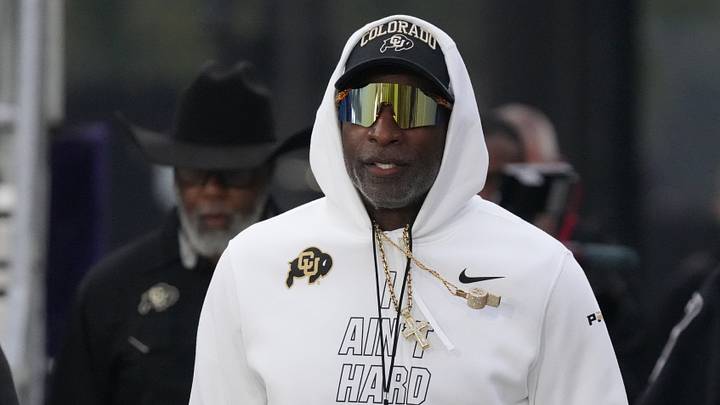
Colorado wanted Deion Sanders for the long haul. The school may no longer have much of a choice.
A 2–0 start restored hope that last season’s 3–9 collapse was an aberration. One disastrous half against Northwestern nearly erased it.
Colorado entered halftime trailing 21–0, delivering the type of lifeless performance that inevitably brings questions about the direction of the program back to the surface.
With everything surrounding Coach Prime, the reactions are exaggerated. Every victory becomes evidence that Colorado is ready to compete for a championship. Every ugly performance raises questions about whether Sanders can build a sustainable winner in Boulder.
Those questions are fair.
Sanders entered Saturday with an 18–21 record at Colorado. He inherited a program coming off a 1–11 season and engineered a remarkable turnaround, improving from four victories in 2023 to a 9–4 finish and Alamo Bowl appearance in 2024.
Colorado then crashed to 3–9 last season.
Colorado made an enormous commitment
In March 2025, Colorado gave Sanders a five-year, $54 million extension running through 2029. He received $10 million in 2025 and another $10 million in 2026, followed by $11 million in both 2027 and 2028 and $12 million in 2029.
At the time, the investment was understandable.
Colorado reported that more than 54 million viewers watched the Buffaloes during the 2024 season. Home games generated an estimated $93.9 million in direct economic impact for Boulder and $146.5 million across the region. Applications to the university increased 20%.
Sanders had made Colorado relevant again.
“We’ve just scratched the surface of what this program can be,” Sanders said when the extension was announced. “I’m committed to bringing greatness to this university, on and off the field.”
The situation looked considerably different following a three-win season but Colorado’s first half against Northwestern offered another troubling reminder of how far the program still has to go.
Colorado said no tuition or state funding would be used to pay Sanders. His contract is funded exclusively through the athletic department’s media-rights revenue, ticket and merchandise sales, donations and sponsorships, according to CU's announcement at the time.
Firing Deion Sanders could cost $33 million
Colorado confirmed reports that its athletic department was projected to finish the 2025–26 fiscal year with a $27 million deficit.
That does not necessarily mean the university lacks access to the money required to make a coaching change. It does make finding tens of millions of additional dollars exceedingly difficult to imagine.
According to The Denver Post, Sanders is owed 75% of his remaining base and supplemental salary if Colorado fires him without cause.
Depending on the timing, firing Coach Prime during 2026 could leave Colorado responsible for as much as $33 million. The reported obligation would fall to $25.5 million after the 2026 season, $17.25 million after 2027 and $9 million after 2028.
Even those figures do not represent the entire expense.
Colorado could face additional costs involving Sanders’ staff before finding enough money to hire a new head coach and give him the resources required to rebuild the program.
Colorado paid him like a championship coach before he built a championship program. The university was betting that Sanders’ national visibility, recruiting appeal and economic impact would eventually produce sustained success on the field.
That bet can still pay off. Colorado’s season is far from over, and Sanders has previously demonstrated how quickly he can change the program’s direction.
But the first half against Northwestern provided a frightening glimpse at the alternative.
If performances like this continue, Colorado may discover that firing Coach Prime would create an even bigger nightmare than keeping him.
 Add us as a preferred source on Google