

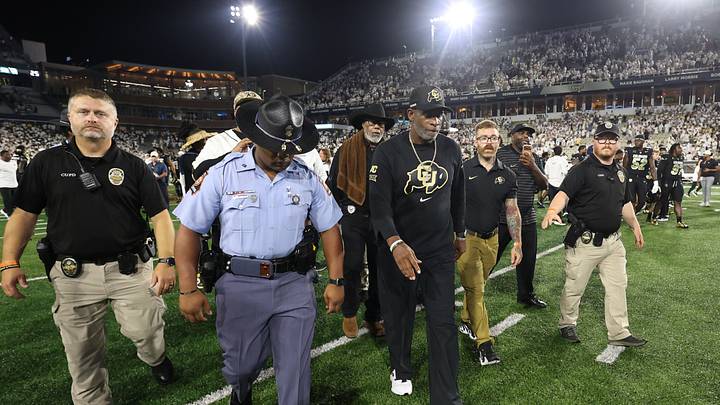
Colorado’s struggles are showing up on the field and in the flow of information coming from its official channels. The off-field criticism here is not about student-athletes’ classroom performance. Student-athlete academics have been a recurring strength during the Coach Prime era, with Colorado announcing record-setting GPAs multiple times. Most recently, CU reported back-to-back department-wide semester GPA records, while the football team posted its best spring GPA at 3.004.
The questions are about how Colorado communicated the dismissals of three players.
At his weekly press conference Tuesday, after Colorado’s 41-7 loss at Northwestern, Deion Sanders said three players were no longer with the Buffaloes. He did not identify them. CU’s communications staff told BuffBlitz publisher Brian Howell, “Officially, any potential roster changes have not been finalized. An updated roster will be released later in the week.”
Saturday’s Baylor press-box roster appeared to show no cuts, according to BuffStampede’s Leo Rivera IV. A manual comparison of earlier printed rosters with Colorado’s online roster information also found no recent discrepancies that would identify the three players.
Earlier this week, Uncle Neely said on his podcast with Chico Cleveland that he and Chico knew which players were involved. He later confirmed all three played defense.
During his postgame news conference at Baylor on Saturday, reporters asked Sanders to identify the players. He declined and criticized the question.
Reporters finally asked
I had called out the local media earlier in the week for not asking Sanders the obvious question. When reporters did ask, his response was defensive.
“Who wasn’t here today?” Sanders said. He asked whether reporters were asking other schools about players who had left their teams, then added, “I don’t call any names, and I’m not going to [throw] any team or school up under the bus.”
Sanders also questioned whether reporters had used a search firm to identify the players. He said dismissing players for conduct detrimental to the team had happened “every year.” But he did not explain why CU had said roster changes were still being finalized or why Saturday’s press-box roster showed no apparent cuts.
It is possible Sanders was responding to broader social-media criticism, not only to the question asked in the room. What is clear is that reporters asked him directly, and he would not provide the names.
Who was in the loop?
The ongoing and likely unnecessary saga brings to mind broadcaster Tim Brando’s recent comments about the changing role of college sports information directors. Brando said SIDs now have to go through operations staff to reach head coaches, describing a system in which communications staff can have less influence and less direct contact with decision-makers.
That broader observation does not establish what happened inside Colorado. But it certainly raises the question as to whether CU’s communications staff know which players Sanders had dismissed when it told Howell the changes were not finalized, or had the football operation left them out of the loop?
If the staff knew the dismissals were final, the university’s statement and the unchanged press-box roster need explaining. If it did not know, Colorado’s communications team may have been working without the full knowledge of a major decision by its own head coach.
Which raises the even more alarming question: Does Uncle Neely have greater access to personnel information than Colorado’s Athletic Communications Department? Right now, it sure seems that way.
 Add us as a preferred source on Google