

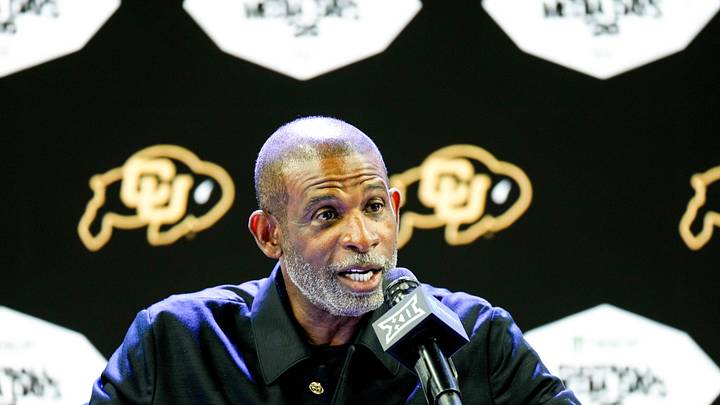
Deion Sanders did not shy away from the subject.
During his weekly press conference, the Colorado head coach revealed that “a few guys” were no longer with the team following the Buffaloes’ loss at Northwestern.
The press conference included more follow-up than it might have initially appeared. One reporter asked Sanders whether the departures resulted from a pattern of behavior or a single incident.
“It’s never one,” Sanders said. “When you start being conduct detrimental to the team, that will set us back, and things that you’re doing that you don’t care about the team, you care about you, I have a problem with that.”
When asked whether he consulted anyone else before making the decision, Sanders was just as direct.
“That’s me,” he said. “I ain’t got to consult with nobody to do what I know was right.”
Those questions produced useful answers. Reporters learned why Sanders made the moves and that he considered the decision his alone.
One basic question, however, was never asked: Which players were no longer with the team?
That omission stood out because Sanders spent part of the same press conference emphasizing how straightforward he tries to be with reporters.
“Some things I really tell you the truth and you don’t believe me,” Sanders said. “Have I lied to you one time? Have I told you the truth the whole way?”
He later added, “I try to shoot you guys straight.”
Sanders also showed that he was willing to discuss another personnel matter. When asked whether injured players Demetrius Hunter and Danny Scudero would be available against Baylor, he provided a clear answer.
“No, I don’t expect to see them on Saturday,” Sanders said. “No, not whatsoever.”
That does not mean Sanders was required to identify the players who had been dismissed.
Coaches regularly protect personnel information when they believe it could help an opponent. New York Giants coach John Harbaugh, for example, declined to tell reporters who would be available before his team’s opener against Dallas.
Harbaugh’s approach was fair. Sanders’ decision to provide an injury update on Hunter and Scudero was fair, too.
One or more of Colorado’s departed players might have figured into Baylor’s preparation. Sanders could have declined to provide the names for competitive or personal reasons.
But nobody could know how he would respond until the question was asked.
While credentialed reporters left the identities unresolved, longtime Coach Prime confidant Uncle Neely indicated on TMR Live that he knew who was involved.
“Names are coming,” Neely said. “I know the names.”
Neely said three players were involved, although one might be able to reverse the situation. He also indicated that some parents might not yet know. If that was the case, Sanders would have had a reasonable basis for withholding the names publicly.
The issue soon spilled onto social media, where Colorado media personalities disagreed over whether the players should be identified and whether reporters had handled the announcement appropriately.
DNVR’s Scott Procter and Jake Schwanitz, who attended the press conference, said they expected the identities to be “revealed to us all very soon.” Others raised privacy concerns.
Those concerns are worth considering. A reporter could learn the identities, confirm the information and still decide that immediately publishing the names would be inappropriate.
Brian Howell of BuffBlitz also deserves credit for contacting Colorado after the press conference. The university responded that “any potential roster changes have not been finalized” and that an updated roster would be released later in the week.
That statement added another layer of uncertainty because Sanders had spoken about the moves as decisions he had already made.
The communications department might have been exercising caution while the process continued. Sanders might also have declined to provide more information if asked.
Either answer would have been informative.
 Add us as a preferred source on Google