

Julian “JuJu” Lewis began the season as the quarterback Colorado expected to build around. Five games later, there is now a legitimate question about whether he will ever take another snap for the Buffaloes.
Lewis did not play during Colorado’s 29–7 loss to Texas Tech on Saturday. Isaac Wilson started and completed 26 of 44 passes for 290 yards, one touchdown and three interceptions. Freshman Kaneal Sweetwyne also received limited playing time while Lewis remained on the sideline.
Then the speculation intensified.
Matt McCall, a Colorado alumnus who posts on X as “Moneyline Matt,” claimed Lewis’ camp had informed Deion Sanders and the Colorado staff that the quarterback was finished playing for the Buffaloes. McCall wrote that Lewis planned to sit out the remainder of the season before entering the transfer portal.
Neither Lewis, his family nor Colorado has confirmed that claim.
However, Sanders’ comments after the Texas Tech loss suggested Lewis’ absence involved more than a routine depth-chart decision.
“I would love for JuJu to come in here and he tell you what happened,” Sanders said. “So don’t, ‘You benched JuJu, first and third string.’ No, that’s not how it went down. It didn’t happen like that.”
Sanders’ invitation for Lewis to explain the situation sounds reasonable until Colorado’s media-access policies are considered.
Reporters cannot simply walk into the football facility and ask Lewis what happened. The university and football program determine which players are made available for interviews. Unless Colorado places Lewis in front of reporters, Sanders is directing the media toward a source it may have no opportunity to question.
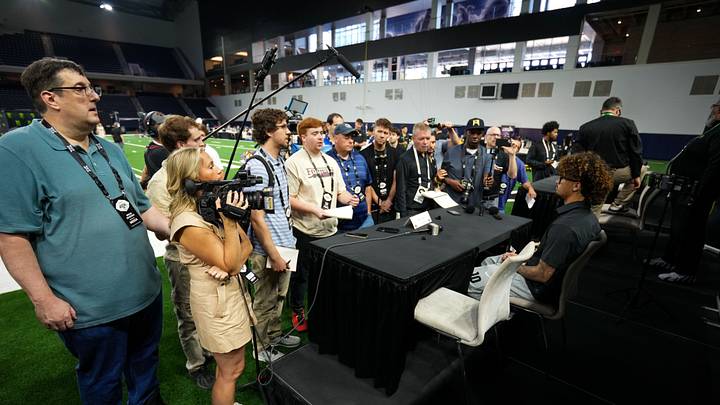
The limitations became especially apparent during Wilson’s postgame press conference Saturday. Several Colorado beat reporters introduced themselves to Wilson before asking their questions, an apparent sign that this was the first time they had spoken with him in that setting.
Wilson had just made his first start for Colorado in a nationally relevant conference game, yet some of the reporters who regularly cover the program appeared to be meeting him for the first time. That makes Sanders’ suggestion that reporters should ask Lewis what happened even more difficult to accept.
If beat reporters had not previously received meaningful access to Wilson, what reason is there to believe Lewis will suddenly be made available to explain one of the program’s most sensitive personnel situations?
This is not the first time Sanders has responded to a question by suggesting that reporters ask a player or staff member who is not regularly available. It allows him to avoid speaking for someone else, but it can also function as a deflection when the program controls access to that person.
Colorado has developed a reputation for tightly restricting outside access. Before the season, reporters attending open practices were prohibited from publishing observations about injuries, personnel groupings, player performances or depth-chart movement. The university also warned that violations could lead to removal, credential revocation or future access restrictions.
Sanders may sincerely want Lewis to tell his own story. If that is the case, Colorado should make him available.
Until then, speculation will continue to fill the information vacuum.
 Add us as a preferred source on Google