

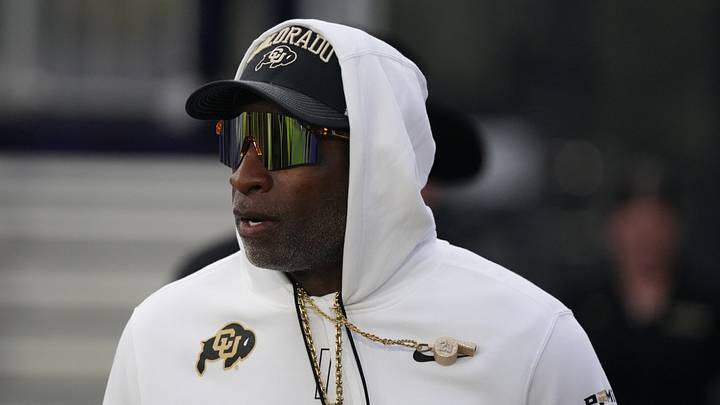
Colorado firing Coach Prime would be far more complicated than simply deciding Deion Sanders has not won enough football games.
Sanders remains one of the biggest personalities in sports, and his contract reportedly gives him a $33 million buyout if Colorado fires him after the 2026 season. Any decision would therefore require the Buffaloes to identify a replacement capable of justifying that enormous financial commitment.
Colorado would also be choosing the direction of the program after Coach Prime. Does it preserve the offensive system surrounding Julian Lewis? Hire a proven program builder? Pursue another nationally recognized name? Or make an affordable investment in someone with deep Colorado connections?
Here are five potential replacements who would give athletic director Fernando Lovo distinctly different options.
Brennan Marion
Marion would be the most natural choice if Colorado wants continuity.
The current Colorado offensive coordinator already understands the roster, has a relationship with Lewis and could preserve the Go-Go offense he brought to Boulder. That continuity could help prevent the type of roster exodus that often follows a coaching change.
Marion also has head-coaching experience after spending the 2025 season at Sacramento State. He is young, innovative and has built a reputation as an effective recruiter during stops at Texas, Pittsburgh, UNLV and other programs.
The concern would be whether Colorado wants to promote someone from Sanders’ staff after deciding the overall program requires a change. Marion’s candidacy may ultimately depend upon how well his offense performs throughout the remainder of the season.
If the offense thrives while other areas collapse, Marion should receive the first interview.
Jason Eck
Eck might be the most logical external candidate because Lovo already knows what he can do.
Lovo hired Eck at New Mexico, where the coach inherited a program projected to finish 11th in the Mountain West. Eck immediately led the Lobos to a 9–4 record, a tie for first place in the conference and their first bowl appearance since 2016. He was named Mountain West Coach of the Year.
Before arriving at New Mexico, Eck went 26–13 at Idaho and reached the FCS playoffs in all three of his seasons.
There is also a Colorado connection. Eck served as a Buffaloes graduate assistant from 2002–03, meaning he already understands Boulder and the program’s potential.
Eck would not generate the national headlines that followed Coach Prime, but he has demonstrated an ability to build successful programs with limited resources. If Lovo gets an opportunity to make his own football hire, Eck would be an obvious candidate.
Ryan Walters
Walters would be the affordable homecoming option.
He played safety at Colorado, grew up in Aurora and began his coaching career as a CU student assistant. He later built nationally respected defenses at Missouri and Illinois before becoming Purdue’s head coach.
His 5–19 record at Purdue cannot be ignored. Walters went 1–11 during his second season, and that type of record will rarely earn a coach a third year.
Colorado could nevertheless conclude that Walters, who is now Washington’s defensive coordinator, deserves another opportunity. Purdue is one of the most difficult jobs in the Big Ten, and Walters was given only two seasons to rebuild it.
Brian Kelly
Kelly would allow Colorado to maintain a national profile while making a complete directional change.
Instead of hiring another rising coach, the Buffaloes would be turning to one of the most accomplished available coaches in the country. Kelly went 34–14 at LSU and previously led Notre Dame to two College Football Playoff appearances.
After spending a year outside the spotlight, rebuilding Colorado could offer the type of challenge Kelly might embrace. His experience and name recognition would immediately command attention from recruits, donors and national television networks.
Kelly is owed a reported $54 million following his dismissal from LSU, but his agreement includes a mitigation clause requiring him to seek employment. That could potentially allow Colorado to construct a creative deal without paying him like a traditional coach with his résumé.
He may be more focused on potential openings in the Carolinas. However, Colorado could be an intriguing alternative if Kelly wants to prove he can build another contender outside the traditional power structure.
Gary Patterson
Patterson might be the most fascinating option on the entire list.
He transformed TCU from an overlooked program into a national contender, finishing 181–79 across 21 seasons. Patterson produced 11 double-digit-win seasons, led TCU to a 13–0 record in 2010 and built some of the best defenses in college football.
Now serving as USC’s defensive coordinator, Patterson is in a good position. He could even become a candidate to replace Lincoln Riley if Riley eventually departs.
But Patterson has always appeared more suited to running an entire program than working as an assistant.
Whether there is still some spite remaining from the end of his TCU tenure is impossible to know. Colorado would provide Patterson with an opportunity to build another Big 12 program and reinforce that TCU’s transformation was not an accident.
At 66, he would likely be a shorter-term solution, and Colorado would need to consider a succession plan. But Patterson would not require time to learn how to lead. He could establish the culture, repair the defense and take command from his first day in Boulder.
 Add us as a preferred source on Google